Featured

About this blog.

My name is Adam and I study social science at the University of Wollongong, I’ve created this blog to create a discussion on a particular topic that is related to social justice and inequalities, suicide rates in Australia. This is a topic I topic i have picked as it has a major impact on my life in recent years. It is an issue that I have experienced and is obvious in society and within Australia. Throughout this blog I will try to highlight and place emphasis on the different aspects of inequalities within suicide and try to analyse as to why there are these inequalities in our society. These areas will include suicide rates as a whole, but will then also focus on male rates of suicide, indigenous rates of suicide and the recent rise in suicide rates surrounding women over 45. Below is a link that highlights suicide rates and shows how it is a such current issue.

https://anglicaresa.com.au/6-startling-facts-about-suicide-in-australia/

Youth Suicide Rates

In this Blog post, I will be talking about Indigenous youth suicide, it carries on and relates to my previous blog post ‘Aboriginal Suicide Rates’ but focus’ more heavily on youths.

Adolescence is a particularly stressful time for many youths where many changes to both the physical and mental state of young people occur. These changes impact youths through fear, confusion and high levels of stress associated with their personal experiences with school, family and various other relationships. Because of this suicide is the third leading cause of death for people aged 15-24. The National Institute of Mental Health outline that there are over 25 suicide attempts for one suicide. So, if suicide is already the third leading cause for death for Indigenous youths and there are so many attempts that could escalate those numbers further, what is causing this?

The director of Suicide Prevention Australia has recently called on the government of Australia to invest and fund strategy’s specifically to meet the needs of indigenous people. “We need to remember that Indigenous people know the solutions. We know the answers. We didn’t write the Redfern Statement for a joke… funding needs to be put into Indigenous organisations, into Indigenous hands” (Fryer 2019). The Redfern statement is an urgent approach from the Indigenous community for Aboriginal and Torres Strait Islander affairs. These comments are spoken with serious intention as it is clear from the response from the present government is not resinating with Indigenous youths which is costing them their lives. The government’s current initiatives do not work for the indigenous community the same way it does for the normal population due to their more culturally filled lives and connectedness with the land.

According to the Australian Bureau of Statistics, Indigenous people children (ages 5-17) are 5 times more like to die from suicide compared to non-Indigenous children (ABS 2017).

Without the investment into the correct avenues that will work with indigenous youths to connected with them, suicide rates within Indigenous youths will continue its upward trend. It is a real problem that is impacting only so many peoples live not just the youth that commits the act as for every youth there are friends and family that suffer unspeakable amounts of emotional pain from suicide related deaths.

Aboriginal Suicide Rates

This blog will focus on the rising levels of Aboriginal suicide rates and the impacts that this on the community especially in communities that have a high level of Aboriginal representation.

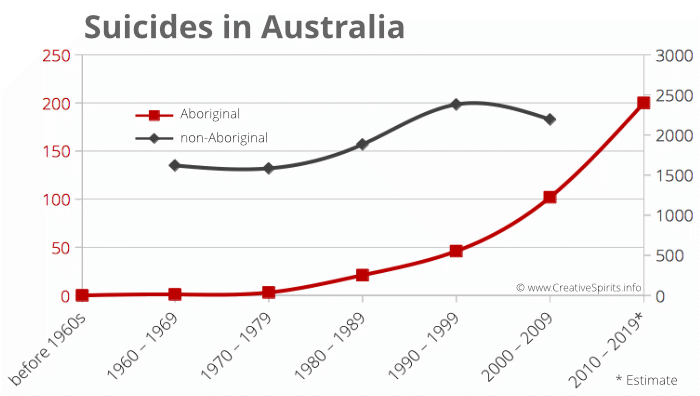
Suicide was almost non-existent for aboriginals until 1980’s, it now has doubled every decade since then. There are so many alarming statistics regarding Aboriginal suicide it is clear that there is an injustice of equality present within the issue, some of these statistics include:

  • 95% of Aboriginal people who are affected by a suicide
  • 50% of all suicides in the northern territory were Aboriginal
  • 40% Proportion the suicide rate for Aboriginal males is higher than non-Aboriginal males
  • 75% of child suicides between 2007 and 2011 where the child was Aboriginal

So, what is causing these extreme numbers?

Aboriginal suicides are mainly related to long periods of suffering, trauma passed on from previous generations and social marginalisation.

Many Aboriginal people are still overcoming intergenerational trauma and suffering from abuse they occurred from when they were children during the stolen generation were many Aboriginals lost their homes, combine with the institutional racism this has had a detrimental impact on the current generations mental state.

Many Aboriginal elders believe that suicide rates are due to the loss of traditional culture and values that has come from being disconnected with the land. A further reasoning is the extreme poverty that many Aboriginal people live in particularly in the northern territory where extreme poverty areas experience the highest level of suicide. Poverty is considered a major factor as Aboriginals living above the poverty line in Australia have a lower rates of suicide then non-Aboriginal Australians (Georgatos 2017).

Graph showing the number of Aboriginal suicides skyrocketing while non-Aboriginal suicides have dropped in the last decade.
Source – https://www.creativespirits.info/aboriginalculture/people/aboriginal-suicide-rates

Racism is still very current and real in Australia’s society and mostly impacts Aboriginal youth with many reports of these youth not being able to deal with the pain associated with such racism in school and other aspects of their lives.

It is clear that there is a substantial amount off reasons as to why Aboriginal rates of suicide are so extreme, butit is the clear neglect from the government into preventing the number of suicides that is of major importance. Until the government treats the matter seriously and recognises the problem in its full extent and invests money into the prevention of suicide, only then will the number of suicides reduce.

References

Georgatos, G 2107, ‘Our governments are not serious about suicide prevention’, Neos Kosmos, weblog post, viewed 18 May 2019, <https://neoskosmos.com/en/43464/our-governments-are-not-serious-about-suicide-prevention/&gt;.

Male Suicide Rates

In this blog post I will be focusing on male suicide rates in Australia and attempting to understand why they the levels at which they are, and the inequalities that come from it.

Every day in Australia six men will take their own lives, according to the ABS “the death rate for males was 19.1 deaths per 100,000 males and represented 75.1% of all intentional-self harm deaths” (ABS 2017).

https://www.news.com.au/lifestyle/health/mind/the-mens-mental-health-crisis-australia-can-no-longer-ignore-six-male-suicides-a-day/news-story/cc77b01572676c8b140424777c3ff642

In recent times there has been increased awareness of the issue and many programs and initiatives aimed are targeting male suicide. Movember is one example of a popular movement which is recognisable by most Australians trying to tackle this issue by raising awareness around the stigma of mental health for males.

Despite these initiatives becoming more common, it is clear that men are less likely to seek help for mental health issues and rates of suicide continued to rise from 2016 to 2017 by 9.1% (ABS 2017). According to Sane Australia’s chief executive, men are less likely to seek help compared to women, with three women contacting them for their services for every man using the services (Molloy 2018).

“Media outlets have a powerful role to play in breaking down the stigma of mental illness and suicide” Sane Australia (2019) found that the mainstream media have a huge influence when impacting on men’s mental health, and that reporting about it sensitively and appropriately can help eradicate public misconceptions and myths about male suicide.

When comparing statistics and looking at sources like Sane Australia it is clear that there is a stigma around male mental health and men that seek help for such this issue. Unless we continue as a society to highlight and take initiative into targeting this problem then numbers will continue to rise, along with the media and the influence they have we can move forward and look to reduce suicide rates rather than increasing these rates.

References

Australian Bureau of Statistics 2017, Causes of death, Australia, 2017, cat. No. 3303.0, ABS, Canberra, viewed 17 April 2019, https://www.abs.gov.au/ausstats/abs@.nsf/Lookup/by%20Subject/3303.0~2017~Main%20Features~Intentional%20self-harm,%20key%20characteristics~3

Molloy, S 2018, ‘The men’s mental health crisis Australia can no longer ignore — six male suicides a day’, News.com.au, 10 October, Viewed 17 April 2019, https://www.news.com.au/lifestyle/health/mind/the-mens-mental-health-crisis-australia-can-no-longer-ignore-six-male-suicides-a-day/news-story/cc77b01572676c8b140424777c3ff642

Sane Australia 2018, Media outlets have a powerful role to play in breaking down the stigma of mental illness and suicide, Viewed 17 April 2019, https://www.sane.org/stigma-files-2018/media-outlets-have-a-powerful-role-to-play?highlight=WyJtYWxlIiwiJ21hbGUnLiIsInN1aWNpZGUiLCInc3VpY2lkZSIsIidzdWljaWRlJyIsInN1aWNpZGUnIiwic3VpY2lkZScsIiwic3VpY2lkZScuIiwibWFsZSBzdWljaWRlIl0=

The Injustice of Suicide

Suicide has a devastating impact on families and society as a whole. In the developed world suicide is a major health problem but considering the developed world is often looked as the favourable place to live, why is suicide so prevalent in countries like Australia?

In 2017, 3,128 people died from intentional self-harm, up 9.1% from 2016 (Australian Bureau of Statistics 2017), with numbers rising at a dramatic number over such a short period of time, this is an issues that deserves a lot of attention to find out why these people are turning to such a serious action that affects not just themselves but all of their friends and families.

Social, demographic and economic characteristics have a major impact when establishing a link between people and suicide, environmental conditions also have an impact as well as individual factors such as mental health (Burns 2016, p. 224). Its these issues that are affecting people and leading them to suicide, but in a developed society with so much access to services, a better understanding of these issues needs to be developed in order to understand how to prevent and reduce suicide in the community.

While over 3000 Australians lost their life from suicide in 2017, over 65,000 make a suicide attempt. In Australia, the National Suicide Prevention Strategy was established to investigate why rates of suicide were increasing (Burns 2016, p. 224). Its major focus was on increasing public awareness and reducing the overall stigma of suicide in Australia whilst also highlighting the importance of providing access to evidence-based suicide prevention activities.

It is obvious that this is such a prominent issue in our society that has such a devastating impact on so many people and families, and the fact that western civilisation is seen as a favourable place to live so we must explore further into why suicide is so prevalent in Australia. In future blogs I will discuss specific groups that are impacted by the injustice of suicide.

References

Australian Bureau of Statistics 2017, Causes of death, Australia, 2017, cat. No. 3303.0, ABS, Canberra, viewed 8 April 2019, <http://www.abs.gov.au/ausstats/abs@.nsf/Lookup/by%20Subject/3303.0~2017~Main%20Features~Intentional%20self-harm,%20key%20characteristics~3&gt;.

Burns, R 2016, ‘Sex and age trends in Australia’s suicide rate over the last decade: Something is still seriously wrong with men in middle and late life’, Psychiatry Research, vol. 245, pp. 224.